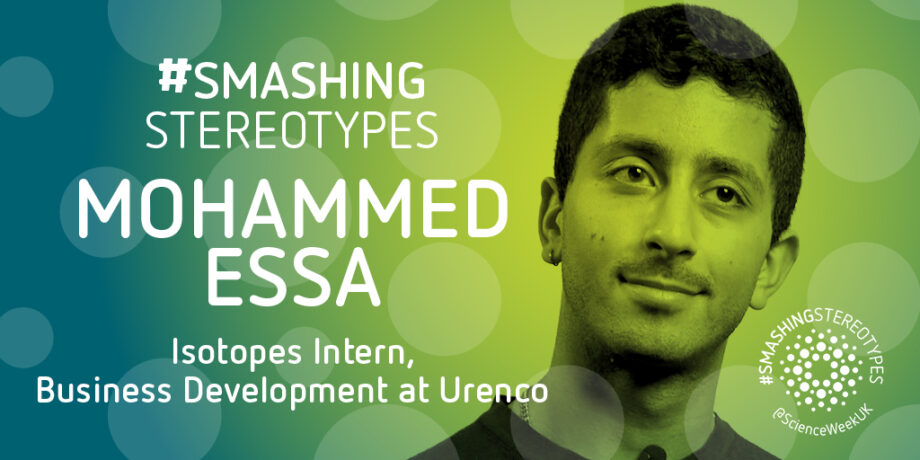
Mohammed Essa
Isotopes Intern, Business Development at Urenco
Learning and growing at the heart of a new industry
Mo Essa spent a year working as an isotopes intern at Urenco after completing his university studies. He was then offered a permanent contract with the company and is looking forward to the next step in his nuclear career. Mo’s family are medics, but he didn’t want to directly follow that path. While originally a little unfocused at school, he kept his options open and found an exciting position in a new and growing industry, after deciding to take a chance and go for it.
I grew up in the north of England, in Liverpool, went to a Church of England secondary school and had a fairly standard set of GCSEs before moving on to a more selective sixth form. That’s where I focused more on science. But I didn’t really know what I wanted to do in the future. Let’s just see where things go, I thought. I was a ‘deal with it when it comes up’ type of person – wait until the last minute, then make a panic decision.
Keeping options open
In sixth form I studied chemistry, biology, physics and maths with an idea to go into something chemistry or maths-related, but I wasn’t sure. My family are all medics but it wasn’t for me, I didn’t want to do Medicine.
Sixth form was a challenge – intense, with a lot of pressure on students, and different in terms of pastoral care compared to secondary school. But I soon got into my stride. When applying for university, I went with Natural Sciences to keep my options open. I didn’t know what I wanted to do afterwards, but thought Natural Sciences would give me a flavour of lots of subjects and that would give me time to decide.
My modules were in chemistry, maths, biomed and statistics. I ended up really hating stats and maths, so went down the chemistry and biomed route. I used to love chemistry in school, but in years two and three of university it was tough. I ended up focusing more on biomed, specifically pharmacology.
Taking a chance on a new industry
The job market when I finished university was tricky. Originally I wanted to go into a research assistant type role, perhaps stay in the university sector, but there was nothing suitable available. So I was working in a restaurant when I applied to Urenco. Working in a restaurant is great way to meet people from all walks of life and you hear some really interesting stories. It is also amazing for developing people skills.
I applied for a job at Urenco through their graduate scheme. At the time I applied, medical isotopes and radiopharmaceuticals was a completely new industry to me. But I fancied a challenge. I’ll apply for it now, then see what it’s all about, I thought.
Radiopharmaceuticals are a specialised kind of drug which contain radioisotopes. These are then used for the diagnosis and treatment of cancer. Using radiation, doctors are able to image and then kill the cancer cells.
It’s been really interesting and a steep learning curve. This is an exciting, new and developing industry. It’s enjoyable being a part of it and also watching it grow while growing in my career myself.
Nuclear is an industry for everyone
Thinking back to school, there was a clear divide in classes. My physics class had one girl in it. That’s sad to see – it should be a subject that anyone and everyone be able to do. Chemistry at school was a bit more evenly split, but at higher education level it seemed heavily skewed male.
When you think of the nuclear industry or physics and engineering, a lot of people will immediately think ‘male dominated’. It’s a shame: if it’s something you’re passionate about, you should feel comfortable doing it. Never feel like you can’t follow your dreams.
It’s why doing outreach work is so important. During my internship at Urenco, a female colleague and I were involved in a STEM careers event at the Royal Institution – there were a lot of girls there, a lot of people still in school. They’re interested, and it’s important we go out and show that it’s an industry for anyone and everyone. Six years ago I was that student wondering ‘okay, what next?’ and then, through Urenco, I got to be here to help.
Never feel put off and think ‘oh I might not be good enough’. There’s a lot of options within the nuclear sector. You might think nuclear and assume it’s all about physics and engineering. But there’s a lot more to it. My work has been involved with clinical trials. It’s such a broad industry.
Improving awareness and understanding of the nuclear industry
I know a lot more about the industry now despite my short time in it. There’s still a way to go in raising awareness of nuclear as an industry particularly within schools and universities, sharing its role in providing carbon-free sustainable energy and in enabling medical advances. We need to show how broad it is, and all the potential applications for nuclear.
A life-changing and life-saving industry
Nuclear has so much potential for good in the world. I think one of the things I found quite challenging at the start was just trying to learn everything about radiopharmaceuticals. Even though it’s quite a new industry, it’s a massive industry. Being new in a team with people so much more experienced than me, I did think at first: will I ever get to that level? You have to pick up speed fast. But then you get into the stride of it.
One of the best parts of the job is feeling like I’m making a difference. We’ve been to conferences before where we hear people’s stories: how radiopharmaceuticals helped them beat cancer. It’s rewarding to know that we’re contributing toward these patient outcomes and having a genuinely positive impact.
We’ve all got different skills that are vital for a team
I recently took part in the Spark! contest, an Anglo-French innovation event for early career people, bringing us together from all sorts of different industries to collaborate on projects relating to Net Zero. This type of event is important – you realise there are all sorts of skills which go toward building successful projects and teams. You don’t have to be really technical, really mathematical – a successful team needs lots of different types of skills.
It has made me see how a lot of career journeys aren’t one-track. People change, they jump ships. Having those sorts of mentorship experiences is essential for helping you see you can be successful and there can be a place for you. It just gives you confidence to put yourself out there a bit more as well. I think that’s something that a lot of young people can struggle with.
At Urenco we have a young person’s network across our global sites. It’s such a good idea when you’re working for a big company, especially for early career employees who might find networking a bit intimidating otherwise. You get to talk to people you might not normally talk to beyond the focused needs of your job, it really breaks down barriers.
Seeing real world applications brings the spark back
There are subjects and skills I’d put to one side at university because I didn’t enjoy them, like data analytics. But they’re integral to my job at Urenco. I’ve been getting back into it again, getting a bit of spark back. It’s important to keep an open mind. It’s only when you see the real world applications sometimes, outside of education, that you start to find something enjoyable and interesting again.
Because of my pharmacology and biomedical sciences background, my role at Urenco has involved monitoring clinical trials, and then doing intelligence gathering as well across the industry – seeing where potential future growth might be for radiopharmaceuticals. Trying to look at the future of the industry as well as current trends.
A big driver for me is making my family proud. What I’m doing didn’t exist when they were starting out. I went into a new industry which they didn’t know about, but they’re happy with it and definitely proud of me!
Go in with an open mind
If you’re thinking about your own career, go in with an open mind. I think at school and university you get fed certain ideas about certain industries or jobs, and what they might be. But STEM is huge. There’s so many different niches – you’re definitely going to be able to find something right for you and something you enjoy.
If you’ve got a curious mindset, you’re going to go far. Stay curious and don’t shoot opportunities down: you’re going to find things that you didn’t even realise were possible, opportunities you didn’t even know existed.
This profile was updated on 01 March 2026.
Click here for more scientists who are Smashing Stereotypes.