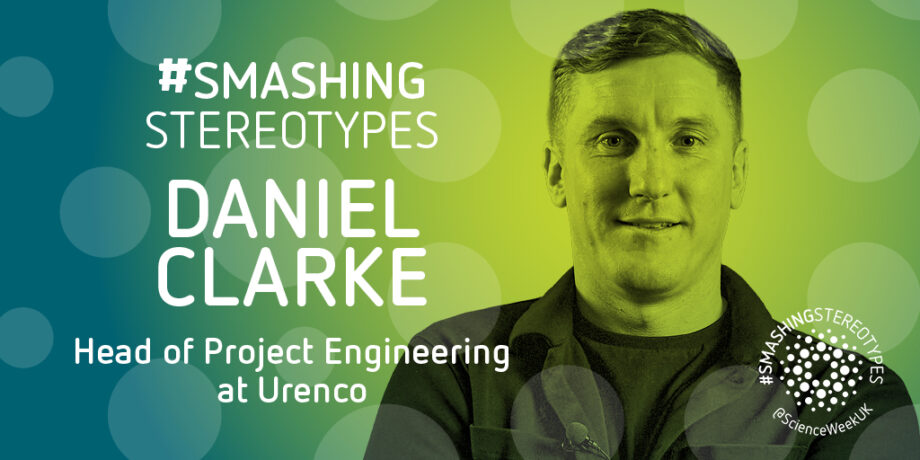
Daniel Clarke
Head of Project Engineering at Urenco
Designing nuclear facilities for a sustainable future
Dan hated school and left after his GCSEs without the grades needed to go into an apprenticeship. But he was ambitious, and very quickly realised that in order to fulfil his potential, it was down to him. He worked hard and found his own route to studying alongside work in a way that made sense to him, continuing to learn and develop. He has ended up travelling the world with his career and now heads a team of 100 engineers for Urenco, overseeing a £1 billion portfolio of work across the UK, Europe and US.
Momentum for nuclear
Climate change has highlighted the need to review global emissions, and as an important source of reliable low-carbon energy, nuclear is part of the solution. When war came to Ukraine, there was a renewed focus on energy independence and a surge in demand for a more diversified supply of enriched uranium. As a global organisation Urenco is well-placed to deliver this world-wide and so it initiated a global expansion programme and major projects portfolio to support the demand worldwide to enable sustainable energy production for generations to come.
I manage around 100 people internationally. My team looks after the Project Engineering for our organisation, which includes Engineering, Construction, Commissioning, Admin, Personal Assistants and Project Coordination. We’re there to ensure, across the project lifecycle, all requirements for the user, design, engineering, manufacturing, construction, testing, commissioning and quality are delivered safely and to the highest standards.
If you think of design as ‘the idea and then turning the idea into a drawing or a model’, and engineering as ‘turning the drawing or the model into a reality’: we oversee and support the design side and then deliver the building side.
Most of my team are qualified engineers, many of them previously apprentices and graduates. They’ve been technicians, been on the tools, been in design offices and then they mature and work their way up and ultimately come to a project engineering position. Some people go straight to project engineering, but quite a few find it through this kind of progression path.
So my job is managing the programmes and portfolios from an engineering, construction and commissioning perspective, which is a challenge to say the least.
Finding a drive and focus
I was someone who absolutely hated school. Despised it. When people say school is the best years of your life, I still say now: absolute rubbish. I liked football, I liked messing around with my mates. There wasn’t much time being put into revision, homework, or thinking about the future. I absolutely hated maths (and still do!).
I wasn’t a dropout or anything like that. I just never really had time for education. I wasn’t interested in it, school was something I just had to get through. For my GCSEs I got some Cs, Ds, even Es. Then it was that realisation of: Oh, I’ve got to do something with my life now. I got a job working in the warehouse for a big electrical products retailer.
But I saw a lot of my friends go into apprenticeships and skilled trades. My grandad at the time was an electrician, my uncle was a mechanic and my dad a joiner and I had thoughts about going for one of those trades, as I had always been interested in building things, doing stuff with my hands, things like bikes, cars and even go-karts. But they pushed me to better myself and to want to make more for myself in a career and find opportunities to thrive in a technical world.
The only subject I’d really enjoyed at school was Design Technology: science for me was too theoretical. But DT was making things, creating, not being sat behind a desk. I thought, I’ll go for an apprenticeship. Apprenticeships were really popular then across the UK, there was a big push on doing them. I applied for one when I was 16 but didn’t get it because my grades weren’t good enough.
Plan B was going to college off my own back to do a foundation or entry-level apprenticeship, so I didn’t have to redo GCSEs and potentially still miss out on an apprenticeship. The college did an entry-level engineering maths programme and that bumped my grades up. Following a year of dedicated work and really enjoying learning and development (because it was something I had chosen to do, rather than being told I had to do it) I was successful getting into the apprenticeship scheme the year after and started at 17.
Taking every opportunity to learn and develop
My apprenticeship was with the company Quinn Glass – that’s changed its name multiple times now – but it was effectively building a brand-new plant in Cheshire, which was half built at the time I started.
It was great to do my apprenticeship alongside something being built rather than already established. I got to sit alongside multiple suppliers from multi-million-pound industries. So my apprenticeship was a very steep, quick learning curve. From that point I quickly realised that in order to better my career and further myself, it was down to me. I relied on no one.
I did my apprenticeship and I immediately left, mainly because I thought I will always be seen as ‘the apprentice’ and the development path would take an awfully long time if I just let it naturally flow.
So I just took a lot of opportunities very early on in my career wherever I felt I could.
Through developing and moving to a higher position, I was then able to do a degree in electrical and control engineering at Liverpool John Moores University, sponsored by my employer. I was going to classes on Friday afternoons, lunch time until nine at night, while still working Monday to Friday.
I did that for four years and that was tough, especially for someone who didn’t do well at school. It was difficult. I had to really change my mindset and study on Saturdays and Sundays. You just have to knuckle down, put the effort in. I came out with a First and ultimately from there just had one goal: I wanted to get to the top. I took every opportunity I saw with open arms, and that’s how I got to my position today.

Learning from the best
In my previous job before Urenco, I was a lead engineer. They had something like 40 different business units globally and realised that was inefficient, so they merged all 40 and then just put it into entities – UK, Europe, South America, America and Asia. The UK was deemed a failing business at the time, so they brought a director from the business who was a specialist in building and establishing Engineering and Design organisations globally for the company. He’d built organisations in Mumbai, Shanghai, St Petersburg Moscow, Abu Dhabi, Germany and Holland.
I knew immediately this was a real opportunity to learn from the best and I shadowed him, perched on his shoulder and learned everything for four years. I was Head of EC&I at the time and became Head of Engineering and Design for the UK and Europe within one year of him starting. Four to five years later, I’ve moved companies and I’m Head of Project Engineering at Urenco.
This wasn’t what people might call a ‘natural’ path. As someone who hated school, failed school, and didn’t follow a natural path of study, having to do a degree on a Friday afternoon, further my development all in my own time, I had to really knuckle down. I just took every opportunity I could possibly get.
Promoting access and inclusivity
The fact that some companies have dropped how many apprentices they take now, or scrapped programmes entirely, is awful for inclusivity and finding and maintaining future generations of engineers and talent.
It can also be difficult for schools to show young people the range of options out there for engineering as a career – it’s only through getting out of the school environment that it opens up. It’s a real shame “Engineering” is not a subject taught at school, so pupils can see the real, broad, world of engineering out there.
Working in a previous organisation, I was involved in STEM events for disadvantaged communities in areas like Hull and Grimsby, mainly the North East. We had a stall and used virtual reality to show young people how, when you design buildings you can use it to walk around them, giving them an insight into a modern world of engineering and trying to relate it to almost a game environment to show children it isn’t just pen and paper.
I believe that the tactic shouldn’t really be trying to push young people in a certain career direction, but trying to show them all the options, things they might not know about. And from that show how it’s really cool and interesting, and something that can be achieved if you work hard and take opportunities, regardless of how well you do at school.
For young people who don’t really know what they want to do with life, I hope I can be a bit of an example, that you don’t have to be a genius or academically amazing or really ‘clever’: you can get there, it takes great determination and effort. But anyone and everyone can.

This profile was updated on 03 March 2026.
Click here for more scientists who are Smashing Stereotypes.