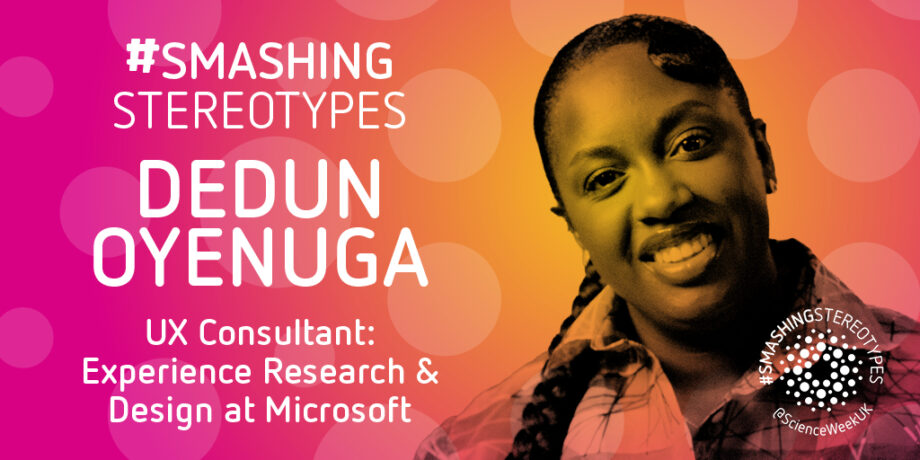
Dedun Oyenuga
UX Consultant Experience Research & Design at Microsoft
Putting people at the heart of technology
Dedun Oyenuga is a UX Consultant specialising in Experience Research and Design at Microsoft. With a love of both the arts and sciences, she deliberately avoided a typical ‘STEM’ path, instead combining these interests through her A-Levels and in her degree in Design Engineering at Imperial College London. A trailblazer in her field, Dedun puts people at the heart of technology in her role at Microsoft and as co-leader of the company’s first Black employee support network in the UK.
Finding a career path that blends STEM and creativity
As a User Experience (UX) consultant at Microsoft, I work on the development of custom products (think mobile and web apps) for major global brands. My core focus is to learn what users need by engaging with them. Using these insights, I design products that are easy and enjoyable to use.
Like many careers in STEM, I had no clue what UX design was when I was at school. At sixth form, students are often encouraged to imagine a clear path, either a STEM route with subjects like Maths, Physics and Chemistry, or a creative route through the arts and humanities.
I’m Nigerian, and although neither of my parents worked in science, education was extremely important in our household. Learning was valued, and they really instilled that in me. We would go to the public library or the bookshop every weekend. I was encouraged to read a lot; both fiction and non-fiction and I think that’s where my love for learning started.
In school, I loved science, but honestly, I loved everything. I was one of those children who genuinely enjoyed all my subjects and didn’t want to give any of them up. For my A-Levels, I studied Maths, Physics and Art, and took an AS-Level in Spanish, which I later dropped.
You don’t have to choose between STEM subjects and creative subjects so early on. Hybrid paths do exist, and it would be great if more students were aware of that. If Maths and Physics are your thing, great. If Art is your thing, that’s fine too. You don’t have to rule one out to pursue the other.
I genuinely enjoyed all my subjects, and that led me to study Design Engineering at Imperial College London for four years. The course combined technical skills such as coding and robotics with a strong focus on design research.
After graduating, I joined Microsoft as a cybersecurity consultant. The transition into work was challenging, but my broad degree gave me flexibility. I knew I had options and although I wasn’t entirely sure what I wanted yet, I felt open to exploring.
After a year I realised cybersecurity wasn’t for me. I thought about my degree and how it could map onto roles within a company as big as Microsoft. I began speaking to people in design teams and eventually moved into UX.
Improving the user experience in tech
UX has been around for a long time, but people still don’t know much about it. I often work on projects with technical teams who have never worked with UX before or have a narrow perception of what it entails.
Before any project, I explain what I do and why it matters. That can be challenging, constantly advocating for your role, but it also leads to strengthening team relationships.
Technical teams often get enthusiastic and want to instantly jump into building a product right away. My role is to take a step back, slow things down and ask questions: Why are we building this? Who is it for? Who benefits? Who might be impacted indirectly? What are the social implications?
I really enjoy the combination of working on both pro-bono and commercial projects. Earlier this year, I led a UX redesign for a financial nonprofit dedicated to connecting women with financial advisors, supporting 25,000 women across the US.
Driving representation with a support network for Black employees in Microsoft
Aside from my core role, I’ve been able to have a wider impact at Microsoft by helping to improve Black representation by setting up a dedicated support network for Black employees. While at university, I completed a six-month placement at Amazon. Working in another big tech company really shaped my expectations early on, particularly through my involvement in Amazon’s Black Employee Network. I quickly saw the value of these spaces that provide connection, visibility and support.
Joining a global organisation with more than 200,000 employees was overwhelming. Although I was fortunate to have a great manager and a supportive team, two months in, I found myself searching for something more: people who shared similar lived experiences. I wanted to see other Black people thriving and progressing within the company. After speaking to my manager, she encouraged me to set something up. From there, I organised an online coffee call with about 40 Black employees across the UK. It wasn’t a huge number, but it was a start. It certainly didn’t represent every Black employee at Microsoft UK, but it was about getting the word out.
Two years on, the community has grown to around 200 members. I led the network on my own, then formed a small group. There were four of us initially, and Anjola, another Smashing Stereotypes profile, who was part of that founding team became my co-lead about six months in.
Together, we’ve been able to work on some exciting initiatives, including partnering with the NHS to support blood donations, organising educational sessions and skilling programmes for colleagues, collaborating with HR to increase diverse hiring, and producing Black History Month video campaigns published by the company.
Mentorship, community and giving back
I feel strongly about inspiring more young people into STEM and have been involved in several community-focused projects and mentorship programmes for young people, including Black Girls in Tech and WCAN, both of which are fantastic organisations.
Working with young people is really where my passion for building supportive networks and widening representation began. My first job at 16 was with Explore Learning, a tutoring centre chain across the UK, where I spent eight hours a week teaching Maths, English and Current Affairs to children aged five to 14.
While at university, I worked for a company called Firetech (now absorbed by MyTutor), delivering tech holiday camps. I taught groups of children aged seven to 16 introductory courses in AR/VR and Python. It’s the kind of work I would love to return to in future.
I was also involved in a mentoring scheme where I was matched with someone more senior – but I was the mentor. She worked in health but wanted to transition into cybersecurity, which was my specialism. We managed to get her a role in just three months, which was exciting. That experience highlighted the value of reverse-mentoring and taught me how to build an effective mentoring framework, as well as recognise the skills I could share, even with someone further along in their career.
Rethinking how we present STEM to young people
To inspire more young people into STEM, we need to show young people the diversity of roles and subject areas that exist in STEM.
There’s a huge range of opportunities and paths, and children need to know what’s out there. Maths isn’t just theoretical; it can have real, tangible impact. STEM isn’t separate from everyday life – everything is connected.
We also need to create a stronger sense of belonging in STEM. For example, even though girls tend to outperform boys academically across subjects, they often gravitate towards non-STEM fields.
Part of this comes down to how we present STEM. We often frame it as difficult, but it’s no harder than languages, English or the humanities, it’s just different. Labelling it as “hard” can be damaging and knock confidence, even unintentionally. Parents, teachers and those around young people need to be aware of that.
Young people should be able to explore freely, find out what works for them, and if they realise something isn’t for them, that’s completely fine, but only if they’ve genuinely been given the chance.
This profile was updated on 26 February 2026.
Click here for more scientists who are Smashing Stereotypes.