We’re delighted to partner with Bloomsbury Children’s Books on a giveaway of a set of their books during the British Science Week 2026, ‘The Bedtime Book of Impossible Questions’ series by Isabel Thomas.
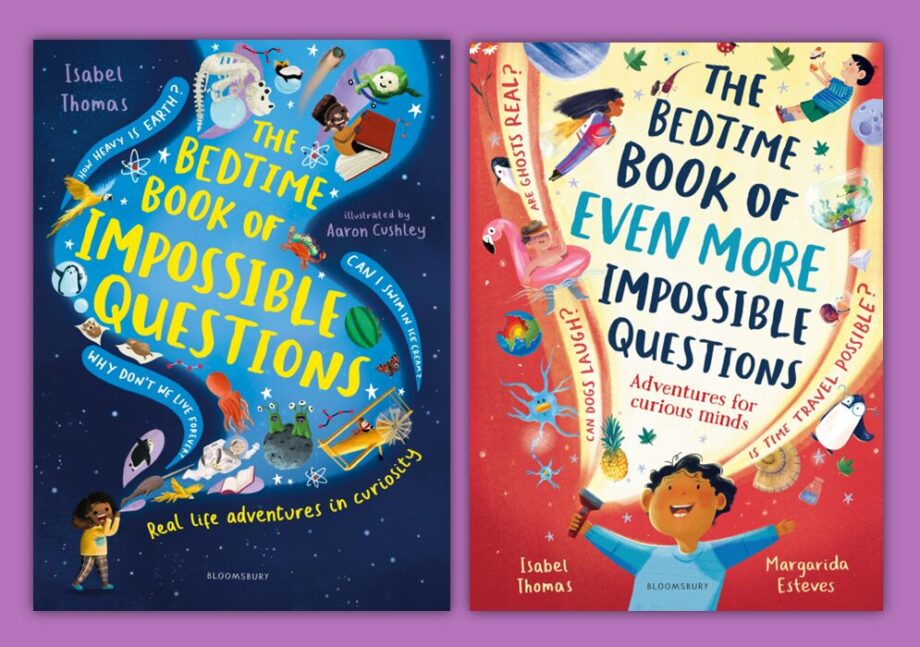
Written by author Isabel Thomas and illustrated by Aaron Cushley and Margarida Esteves, the books are all about meeting children’s amazement at the world with science – a tremendous tie-in with our theme for 2026 ‘Curiosity: what’s your question?’.
The books are aimed at children aged around 7-9, but could be enjoyed by children learning at that level, or younger with the support of teaching staff. They’re full of the sorts of questions that pop into children’s heads just before bedtime, like ‘Why do we have two ears?’ and ‘Can dogs laugh?’ The wide ranging questions develop children’s critical thinking as well as their creative skills. Featuring answers that are succinct, imaginative and informative, these books are perfect for reading aloud in short snippets.

Isabel Thomas is the author of a galaxy of books for young audiences. She has has written over 150 books about science for young readers. She is also a double winner of the AAAS Prize for Excellence in Science Books. Her bestselling titles include The Bedtime Book of Impossible Questions (Bloomsbury, 2022) and Moth: An Evolution Story (Bloomsbury, 2018). Isabel grew up in a low-income one parent family and went on to study Human Sciences at the University of Oxford and Educational Research at the University of Cambridge. As well as books, Isabel writes features for science magazines and the BBC and helps to design outreach projects for a wide range of organisations, inspiring children from diverse backgrounds to pursue science.
How to enter the lucky draw?
The BSA is hosting a lucky draw on BSA’s Instagram for this giveaway activity. Enter the lucky draw by 23.59pm 16 March and be in with the chance to receive these books for your school!
The winner of the giveaway will receive The Bedtime Book of Impossible Questions and The Bedtime Book of EVEN MORE Impossible Questions. The former was named one of the best children’s books of 2022 by The Guardian.
How to enter:
- Follow @BritishScienceAssociation on Instagram
- Follow @isabelthomasbooks on Instagram
- Like the Instagram post by 23.59pm 16 March 2026
- You must be a teacher and must have and provide a UK school email address, and a UK school address later when contacted as the winner
Please read the full T&Cs of this activity before you take part:
Isabel wrote a blog for young minds to read during the British Science Week – where can curiosity lead you? You may find the answers in the blog!
Start a curious question
By Isabel Thomas
Have you ever started a collection? As a child I collected shells and cuttlebones from the beach. As a teenager, it was petals pressed between paper, and pinecones that open and close as the weather changes. Science writing led me to a second-hand collection of moths, rag-winged and faded after being displayed in a museum for decades. And now I’m trying to collect the building blocks of the universe – every element on the periodic table.
But my favourite collection is bigger and better than all of these. It began with a sticky note sent home by my son’s teacher: If frogs lay eggs, where did the first frog come from? He had asked this question after learning about life cycles. It captures what I love about science: no matter how much we find out, there are always more questions.
When you train to be a scientist, you begin with an epic quest: to find a question that has never been answered before. This means scientists are good at asking questions. But children are even better. I’ve collected thousands of questions asked by children at festivals and school visits. (I’ve just returned from the fantastic Norwich Science Festival with a fleet of new questions, delivered by paper aeroplane!) The best questions make connections between unexpected things.
Can dogs swim in ice cream?
Could a slug go into space?
Are feelings made from atoms?
At first, they might seem impossible. But when I hear questions like these, I really, really, really want to know the answers. So I start exploring, by finding out what scientists have discovered so far.
Whatever you’re most interested in – from friendship to frogs to flying saucers – I promise there is a scientist out there studying it. Scientists look for answers in different ways. Some peer through telescopes or microscopes. Some run carefully planned experiments or use fancy machines. Others experiment in their minds, using the language of maths. And a few stumble across answers by accident.
There are so many ways to do science, and you don’t need anything special to get started. You just need to be the kind of person who won’t take “I don’t know” for an answer.
Do plants have feelings?
How big is the universe?
What’s the opposite of a spider?
The history of science is PAVED with questions that once seemed impossible to answer. And now science needs YOUR questions too. Each new question is a stepping stone to understanding the universe and everything in it. It might take you on an adventure through space and time. To deep oceans or distant exoplanets. Into your beautiful brain or into the murky depths of a dinosaur’s bellybutton!
As we continue to experiment, examine and explore the universe, the answers will continue change. As all scientists know, there is no such thing as a perfect answer. But the only question that is truly impossible to answer is the one that never gets asked.
So, start your own collection of improbable, incredible, impossible questions… and let your curiosity lead the way.